
Bladder Cancer Market Anticipated to Witness Remarkable Growth by 2034, Says Latest Industry Analysis | Bristol-Myers Squibb Company, GlaxoSmithKline PLC., Johnson & Johnson, Janssen Pharma, Roche
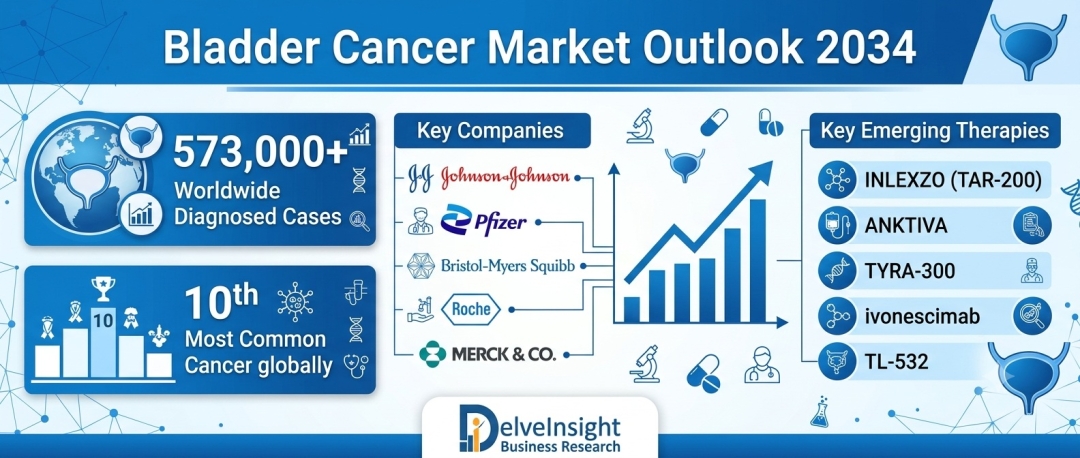
(Albany, New York) – November 04 2026: DelveInsight’s “Bladder Cancer Market Insights, Epidemiology, and Market Forecast-2034″ report offers an in-depth understanding of the Bladder Cancer, historical and forecasted epidemiology as well as the Bladder Cancer market trends in the United States, EU5 (Germany, Spain, Italy, France, and United Kingdom) and Japan.
Got queries? Click here to know more about the Bladder Cancer Market Landscape.
https://www.delveinsight.com/report-store/bladder-cancer-market
Some of the key facts of the Bladder Cancer Market Report:
-
The Bladder cancer market size is anticipated to grow with a significant CAGR during the study period (2020-2034).
-
In October 2026, UroGen Pharma announced that the U.S. FDA has accepted its New Drug Application (NDA) for UGN-103 (mitomycin) intravesical solution, intended for adults with recurrent low-grade, intermediate-risk non-muscle-invasive bladder cancer (LG-IR-NMIBC). The FDA has set a Prescription Drug User Fee Act (PDUFA) target action date of June 14, 2027. The submission is supported by findings from the Phase III UTOPIA trial, in which UGN-103 achieved a complete response rate of 77.8% at three months. Additionally, patients who attained a complete response had an estimated 94.5% probability of remaining event-free at six months.
-
In October 2026, The FDA broadened the approved indication for nogapendekin alfa inbakicept-pmln (Anktiva), in combination with BCG, to include adults with BCG-unresponsive non-muscle-invasive bladder cancer (NMIBC) characterized by high-grade papillary-only tumors. Previously, Anktiva was approved for patients with carcinoma in situ (CIS), with or without papillary tumors. The expanded indication was supported by clinical data from the Phase II/III QUILT-3.032 trial (NCT03022825), which reported a 62% complete response rate in the previously evaluated CIS-containing patient population. This regulatory milestone broadens the availability of Anktiva to an additional group of patients with high-risk NMIBC.
-
In September 2026, The FDA granted Priority Review to AstraZeneca’s supplemental biologics license application for perioperative durvalumab (Imfinzi) combined with neoadjuvant enfortumab vedotin for patients with muscle-invasive bladder cancer who are ineligible for or have refused cisplatin-based chemotherapy. The regulatory submission was supported by findings from the Phase III VOLGA trial, which demonstrated improvements in event-free survival and overall survival compared with standard surgical treatment. This development represents an important regulatory milestone for the combination, although Priority Review should not be interpreted as FDA approval.
-
In August 2026, Summit Therapeutics announced the initiation of the global Phase II/III HARMONi-GU1 trial evaluating ivonescimab, an investigational bispecific antibody, in combination with enfortumab vedotin (Padcev) versus pembrolizumab plus enfortumab vedotin as first-line treatment for patients with previously untreated locally advanced or metastatic urothelial carcinoma. The trial represents an expansion of ivonescimab’s clinical development program into genitourinary cancers, with clinical trial site activations planned for the fourth quarter of 2026.
-
In July 2026, The FDA approved pembrolizumab (Keytruda), or pembrolizumab and berahyaluronidase alfa-pmph (Keytruda Qlex), each in combination with enfortumab vedotin-ejfv (Padcev), as neoadjuvant treatment followed by adjuvant treatment after cystectomy for adults with muscle-invasive bladder cancer who are candidates for surgery. The decision was supported by the Phase III KEYNOTE-B15/EV-304 trial (NCT04700124), which demonstrated significant improvements in event-free survival and overall survival compared with neoadjuvant gemcitabine and cisplatin.
-
In May 2026, The US FDA approved atezolizumab (Tecentriq) and its subcutaneous formulation, atezolizumab and hyaluronidase-tqjs (Tecentriq Hybreza), for the adjuvant treatment of adults with muscle-invasive bladder cancer following cystectomy who have circulating tumor DNA molecular residual disease (ctDNA-MRD), identified through an FDA-authorized test. The approval was supported by the Phase III IMvigor011 trial (NCT04660344), which demonstrated improvements in disease-free survival and overall survival compared with placebo.
-
In January 2026, Shares of ImmunityBio Inc. (NASDAQ: IBRX) jumped 19.8% in premarket trading on Tuesday following the company’s announcement of constructive discussions with the FDA regarding its supplemental Biologics License Application (sBLA) for ANKTIVA in patients with papillary bladder cancer. The clinical-stage immunotherapy company noted that the FDA advised submitting additional data to support a potential resubmission of the sBLA for BCG-unresponsive papillary non-muscle invasive bladder cancer (NMIBC). Notably, the agency did not require any new clinical trials, and ImmunityBio expects to submit the requested information within 30 days.
-
In January 2026, Relmada Therapeutics has obtained important regulatory guidance from the U.S. Food and Drug Administration that could accelerate the approval pathway for its bladder cancer candidate NDV-01 in two high-unmet-need patient groups. The clinical-stage biotech company reported that the FDA issued written feedback endorsing a single-arm, open-label registrational study of NDV-01 in patients with second-line, refractory, high-grade BCG-unresponsive non-muscle invasive bladder cancer with carcinoma in situ, a particularly aggressive and difficult-to-treat disease subtype.
-
In September 2025, Provectus Biopharmaceuticals, Inc. (OTCQB: PVCT) has announced the launch of a preclinical study investigating its lead drug candidate, PV-10, in an orthotopic bladder cancer model, with results expected in early 2026. PV-10 is derived from the company’s pharmaceutical-grade rose bengal sodium. The study, being carried out by Translational Drug Development, LLC (TD2), will assess PV-10 in multiple treatment settings, including oral and intravesical use as a standalone therapy, as well as in combination with an anti-PD-1 checkpoint inhibitor. The findings are intended to provide translational insights to guide future clinical development of PV-10 in bladder cancer and support its potential use in broader immuno-oncology applications for solid tumors.
-
In September 2025, The Food and Drug Administration (FDA) has approved the gemcitabine intravesical system (Inlexzo) for adult patients with Bacillus Calmette-Guérin (BCG)-unresponsive, non-muscle invasive bladder cancer (NMIBC) presenting with carcinoma in situ (CIS), with or without papillary tumors. This approval is supported by data from cohort 2 of the SunRISe-1 phase 2b clinical trial, a single-arm, open-label study. Formerly known as TAR-200, the gemcitabine intravesical system is packaged together with a urinary catheter, which facilitates its insertion directly into the bladder.
-
In September 2025, Predicine announced the completion and submission of the first module of its premarket approval application (PMA) to the FDA, seeking approval for the PredicineCARE urine cfDNA NGS assay as a companion diagnostic for bladder cancer patients. PredicineCARE is a targeted next-generation sequencing (NGS) test developed to identify genomic alterations including single nucleotide variants (SNVs), insertions and deletions, fusions, and copy number variations by analyzing cell-free DNA (cfDNA) from urine and blood samples.
-
In September 2025, Johnson & Johnson (NYSE: JNJ) announced that the U.S. Food and Drug Administration (FDA) has approved INLEXZO™ (gemcitabine intravesical system), introducing a novel and potentially practice-changing treatment for certain bladder cancer patients. The therapy addresses the unmet need for individuals who have not responded to BCG treatment or are unwilling or unable to undergo bladder removal surgery (radical cystectomy). Formerly known as TAR-200, INLEXZO™ is approved for use in adult patients with Bacillus Calmette-Guérin (BCG)-unresponsive, non-muscle invasive bladder cancer (NMIBC) with carcinoma in situ (CIS), with or without accompanying papillary tumors.
-
In January 2025, Preliminary findings from an ongoing study at the Christie Hospital in Manchester provide encouraging support for an investigational therapy targeting the most common type of bladder cancer—urothelial carcinoma. The Christie reported promising patient responses to the new targeted chemotherapy, which is designed to identify and bind to a specific protein present on the surface of certain tumor cells.
-
In January 2025, Pfizer has announced that its Phase III CREST trial assessing sasanlimab in combination with Bacillus Calmette-Guérin (BCG) for induction treatment—with or without maintenance therapy—in patients with BCG-naïve, high-risk non-muscle invasive bladder cancer (NMIBC) has successfully achieved its primary endpoint of event-free survival (EFS).
-
In January 2025, The FDA approved the Investigational New Drug (IND) application for TYRA-300, an oral FGFR3-selective inhibitor, intended for treating low-grade, intermediate-risk non–muscle-invasive bladder cancer (NMIBC). This clearance enables the initiation of a Phase 2 clinical trial evaluating TYRA-300 in this specific patient group.
-
An Estimated 573,278 people were diagnosed with Bladder Cancer WorldWide in 2020
-
Bladder Cancer is the fourth most common cancer among the men
-
There has been a decline of 1%/year in the number of cases of Bladder Cancer in the US from 2009-to 2018
-
Bladder cancer was rated 10th among all cancers in the globe, with 549,000 new cases and 200,000 deaths each year
-
While the specific aetiology of bladder cancer is unknown, it has been related to a number of risk factors, including tobacco use and exposure to certain chemicals and gases. In addition, persons who have a family history of bladder cancer are more likely to get the disease.
-
Key Bladder Cancer Companies: Bristol-Myers Squibb Company, GlaxoSmithKline PLC., Johnson & Johnson (Janssen Pharmaceutical), F. Hoffmann-La Roche., Merck & Co. Inc., and others
-
Key Bladder Cancer Therapies: VPM1002BC, Ascorbic Acid, Avelumab, Cisplatin, Paclitaxel, Mitomycin C, N-803 and BCG, and others
Bladder Cancer Overview:
Bladder cancer is a type of cancer that begins in the tissues of the bladder, the hollow organ in the lower abdomen that stores urine. It most commonly starts in the urothelial cells that line the inside of the bladder. Symptoms may include blood in the urine, frequent urination, pain during urination, and lower back pain. Risk factors include smoking, exposure to industrial chemicals, chronic bladder inflammation, and increasing age. Bladder cancer is typically diagnosed through urine tests, cystoscopy, and imaging scans, and treatment options may involve surgery, chemotherapy, radiation therapy, immunotherapy, or targeted therapy depending on the stage and type of the disease.
To Know in detail about the Bladder Cancer market outlook, drug uptake, treatment scenario and epidemiology trends, Click here; Bladder Cancer Market Forecast
Bladder Cancer Epidemiology
The epidemiology section provides insights into the historical, current, and forecasted epidemiology trends in the seven major countries (7MM) from 2020 to 2034. It helps to recognize the causes of current and forecasted trends by exploring numerous studies and views of key opinion leaders. The epidemiology section also provides a detailed analysis of the diagnosed patient pool and future trends.
Bladder Cancer Epidemiology Segmentation:
The Bladder Cancer market report proffers epidemiological analysis for the study period 2020–2034 in the 7MM segmented into:
-
Total Prevalence of Bladder Cancer
-
Prevalent Cases of Bladder Cancer by severity
-
Gender-specific Prevalence of Bladder Cancer
-
Diagnosed Cases of Episodic and Chronic Bladder Cancer
Download the report to understand which factors are driving Bladder Cancer epidemiology trends @ Bladder Cancer Epidemiology Forecast
Bladder Cancer Drugs Uptake and Pipeline Development Activities
The drugs uptake section focuses on the rate of uptake of the potential drugs recently launched in the Bladder Cancer market or expected to get launched during the study period. The analysis covers Bladder Cancer market uptake by drugs, patient uptake by therapies, and sales of each drug.
Moreover, the therapeutics assessment section helps understand the drugs with the most rapid uptake and the reasons behind the maximal use of the drugs. Additionally, it compares the drugs based on market share.
The report also covers the Bladder Cancer Pipeline Development Activities. It provides valuable insights about different therapeutic candidates in various stages and the key companies involved in developing targeted therapeutics. It also analyzes recent developments such as collaborations, acquisitions, mergers, licensing patent details, and other information for emerging therapies.
Emerging Bladder Cancer Drugs Under Different Phases of Clinical Development Include:
-
TL-532: Tollys
-
AU-011: Aura Biosciences
-
TARA-002: Protara Therapeutics
-
VAX 014: Vaxiion Therapeutics
-
Pemigatinib: Incyte Corporation
-
Erdafitinib: Janssen Pharmaceuticals
-
TLD 1433: Theralase Technologies
-
PF-06801591: Pfizer
-
Nivolumab: BristolMyers Squibb
-
APL-1202: Asieris Pharmaceuticals
Discover more about therapies set to grab major Bladder Cancer market share @ Bladder Cancer Treatment Landscape
Bladder Cancer Market Drivers
-
Rising prevalence of bladder cancer globally, particularly among aging populations and high-risk groups such as smokers
-
Growing adoption of immunotherapies and targeted therapies, including checkpoint inhibitors, improving treatment outcomes
-
Increasing awareness and early diagnosis supported by advanced imaging and molecular diagnostics
-
Strong R&D investments and a robust clinical pipeline focused on novel biologics and combination therapies
-
Expanding healthcare access and reimbursement support in developed markets
Bladder Cancer Market Barriers
-
High cost of advanced therapies, limiting patient access in price-sensitive regions
-
Stringent regulatory requirements and lengthy clinical trial timelines for oncology drugs
-
Disease heterogeneity and high recurrence rates, complicating treatment selection and long-term management
-
Limited treatment options for advanced or treatment-refractory bladder cancer patients
-
Side effects and safety concerns associated with existing therapies, affecting patient adherence
Scope of the Bladder Cancer Market Report
-
Study Period: 2020–2034
-
Coverage: 7MM [The United States, EU5 (Germany, France, Italy, Spain, and the United Kingdom), and Japan]
-
Key Bladder Cancer Companies: Bristol-Myers Squibb Company., GlaxoSmithKline PLC., Johnson & Johnson (Janssen Pharmaceutical), F. Hoffmann-La Roche., Merck & Co. Inc., and others, and others
-
Key Bladder Cancer Therapies: VPM1002BC, Ascorbic Acid, Avelumab, Cisplatin, Paclitaxel, Mitomycin C, N-803 and BCG, and others
-
Bladder Cancer Therapeutic Assessment: Bladder Cancer current marketed and Bladder Cancer emerging therapies
-
Bladder Cancer Market Dynamics: Bladder Cancer market drivers and Bladder Cancer market barriers
-
Competitive Intelligence Analysis: SWOT analysis, PESTLE analysis, Porter’s five forces, BCG Matrix, Market entry strategies
-
Bladder Cancer Unmet Needs, KOL’s views, Analyst’s views, Bladder Cancer Market Access and Reimbursement
To know more about Bladder Cancer companies working in the treatment market, visit @ Bladder Cancer Clinical Trials and Therapeutic Assessment
Table of Contents
1. Report Introduction
2. Executive Summary
3. SWOT analysis
4. Bladder Cancer Patient Share (%) Overview at a Glance
5. Bladder Cancer Market Overview at a Glance
6. Bladder Cancer Disease Background and Overview
7. Bladder Cancer Epidemiology and Patient Population
8. Country-Specific Patient Population of Bladder Cancer
9. Bladder Cancer Current Treatment and Medical Practices
10. Unmet Needs
11. Bladder Cancer Emerging Therapies
12. Bladder Cancer Market Outlook
13. Country-Wise Bladder Cancer Market Analysis (2020–2034)
14. Market Access and Reimbursement of Therapies
15. Market drivers
16. Market barriers
17. Appendix
18. Bladder Cancer Report Methodology
19. DelveInsight Capabilities
20. Disclaimer
21. About DelveInsight
About DelveInsight
DelveInsight is a leading Business Consultant, and Market Research firm focused exclusively on life sciences. It supports Pharma companies by providing comprehensive end-to-end solutions to improve their performance.
It also offers Healthcare Consulting Services, which benefits in market analysis to accelerate the business growth and overcome challenges with a practical approach.
Media Contact
Company Name: DelveInsight
Contact Person: Gaurav Bora
Email: Send Email
Phone: +14699457679
Address:304 S. Jones Blvd #2432
City: Las Vegas
State: NV 89107
Country: United States
Website: https://www.delveinsight.com/consulting/due-diligence-services


